FT Talks Of The Bancor

Recently Financial Times had an article A Keynesian Solution to Global Imbalances (‼) by Daire Macfedden.

Martin Wolf at FT also discussed global imbalances in Why Global Imbalances Matter with the intro text:

They lie at the intersection of almost everything that matters in geoeconomics and geopolitics.

This is welcome, but you need to keep in mind that Bancor is not a complete solution.

In stock-flow consistent models, you can see that the most important things governing the world economy are fiscal policy and international trade. Hence, you get expressions such as

G+X θ+μ

as a first approximation of GDP, where the variables are, respectively: government expenditure, exports, the tax rate, and the propensity to import.

John Maynard Keynes:

  • was right about global imbalances (even if the terminology is more recent),
  • underestimated the importance of trade,
  • and therefore proposed Bancor—not exactly a complete solution.

The main problem is that we live in an economic order with free trade, and deficit countries are constrained from expanding demand because they face balance-of-payments problems, while surplus countries are constrained by an ideology that discourages demand expansion.

Even deficit countries can expand demand until they hit a binding constraint. But the problem is that politicians and the corporations that fund them are often dogmatically opposed to fiscal expansion. So there is a bias toward tight fiscal policy in both surplus and deficit countries.

So, in his plan for Bretton Woods, Keynes proposed Bancor, along with penalties on creditor nations, and also required them to take measures such as:

(a) Measures for the expansion of domestic credit and domestic demand.
(b) The appreciation of its local currency in terms of bancor, or, alternatively, the encouragement of an increase in money rates of earnings.
(c) The reduction of tariffs and other discouragements against imports.
(d) International development loans.

[The Collected Writings of John Maynard Keynes, Volume XXV: Shaping the Post-War World: The Clearing Union, Chapter 1, The Origins of the Clearing Union, 1940–1942]

Now, the Bancor rules work when Bancor balances move outside a certain range. However, Bancor balances are neither the current account balance nor a stock measure such as the net international investment position.

In fact, Bancor balances can be positive even while a country is running large current account deficits and accumulating a large negative net international investment position.

So while the discussion is moving in the right direction, it is important to realise that pundits may downplay the problem in the same way Keynes did, leaving us with a solution that is far less effective than directly targeting measures such as current account balances and the net international investment position.
On Adam Tooze Talking Down Global Imbalances

In his newsletter, Chartbook, in a recent post Chartbook 442: Global imbalances – A new cocktail in old bottles: World Economy April 2026:, Adam Tooze discusses global imbalances but seems dismissive of the problem.

For some, the continuing accumulation of US sovereign liabilities is a worry. It is true that the US Treasury borrows at rates that are higher than for some rich-country sovereigns. But if that is your concern, why start with the balance of payments? If you want to reduce America’s fiscal overhang, issue less debt. In the current moment it is not just American trade policy that is shocking. Never in American history has the country run such a large budget deficit at a time of relatively full employment.

Now that is quite dismissive, especially since the United States is not at full employment. Worse, he comes close to getting it but does not in fact get it: the budget deficit and public debt are large as percent of gdp because of the current account deficits. Having a policy of fiscal contraction would lead to a fall in gdp. Tooze seems to be minimising the causality from the current account balance to budget deficit. Public debt is not itself a problem but reflects the huge negative net international investment position of the United States. Large deficits because the balance of payments situation reduces the expenditure multiplier to bring sufficient taxes in.

From a larger perspective, Tooze offers no solution to all this. Why would he? The purpose of his article is to play down the problem.

Years later, Adam Tooze is going to be writing a mea culpa on how he was wrong on this problem.

The irony is that Adam Tooze is highly influenced by Wynne Godley, who worried about imbalances, and proposed to change the economic order to move toward a system of balanced trade combined with expansionary fiscal policies. In his 2018 book Crashed, Tooze says:

Wynne Godley was a mentor and teacher of a very different kind. Spontaneously warm and generous in spirit, he took me under his cape in my first year at King’s and introduced me, and a group of my contemporaries, to what, at the time, was a highly idiosyncratic brand of economics. In so doing he provided a model of intellectual warmth and vitality. And he confirmed doubts that had been gestating in me about the IS-LM model that was my first great love in economics. Wynne introduced me to the importance of looking “beyond the flows” and insisting on stock-flow consistency in macro models. I don’t think this book, written almost thirty years later, would have been the same without his early influence.


The IMF On Global Imbalances In 2026

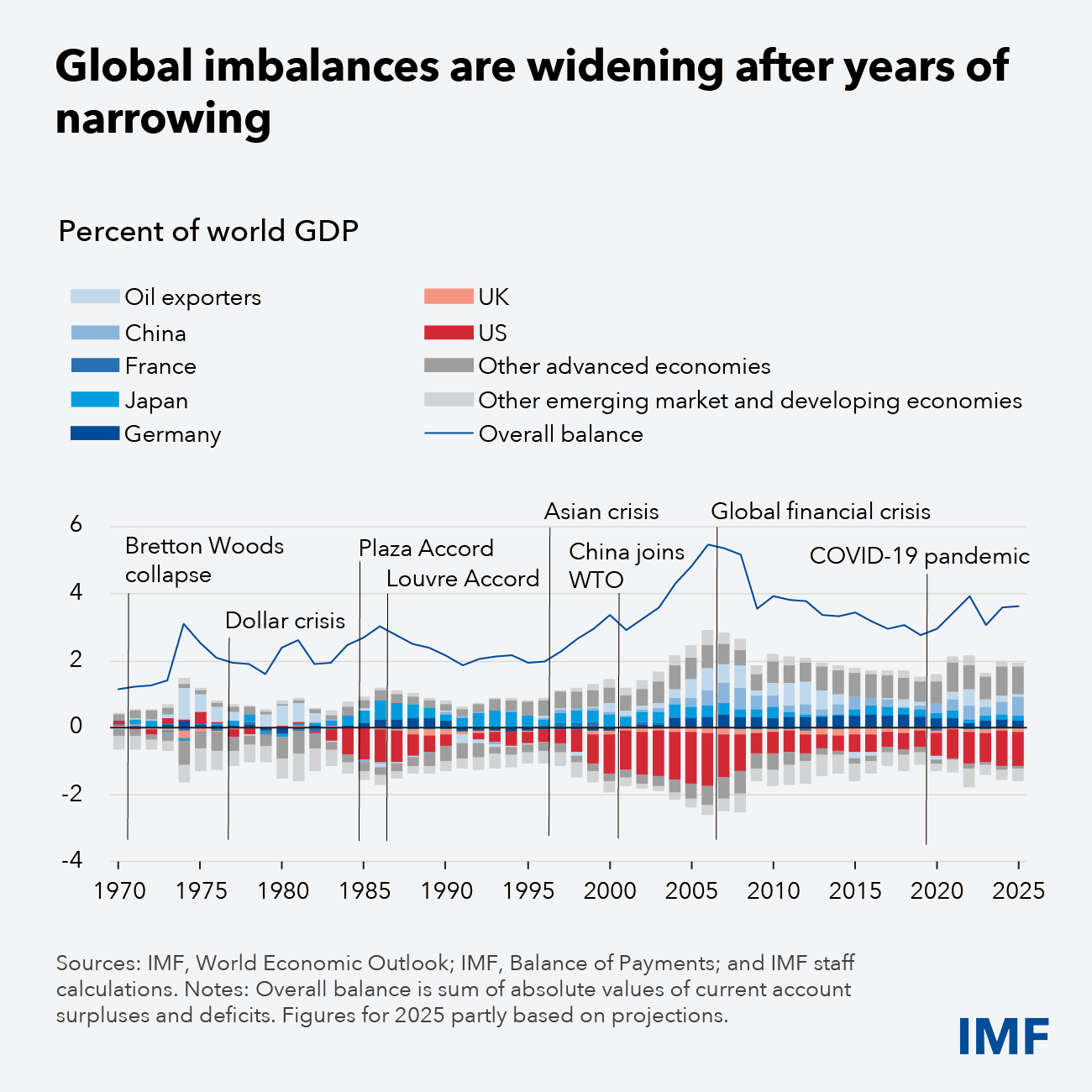
A few days ago, the IMF wrote about global imbalances, with this chart:

Global imbalances in 2026

Source: IMF

The IMF’s analysis uses the identity:

SI = DEF + CAB

where S is private sector saving, I is capital formation (investment), DEF is the government deficit, and CAB is the current account balance.

You can move the government deficit term to the left-hand side, with S and I now denoting the saving and capital formation of the whole country:

S (national) − I (national) = CAB

And just reasoning from the accounting identity, it concludes that, to improve the current account balance, saving has to be raised—and that this should be done via fiscal tightening.

Ugh.

Although it is fascinating that the IMF is at least acknowledging that there is a problem!

However, the IMF’s solution is ridiculous:

This synchronized adjustment would lead to the best outcome for the global economy. The economic drag from US fiscal tightening would be offset by stronger demand from China and Europe. But even if such coordination proves difficult, the best course of action for each country is clear: start addressing domestic imbalances now, regardless of what others do.

The IMF understands that fiscal tightening would slow down the US economy, so it is calling for coordination with China and Europe, which would require them to pursue fiscal expansion. But it is still proposing fiscal tightening even if others do not cooperate, on the assumption that this would pressure them.

There is no guarantee that this would work—it could instead lead to a worldwide recession.

Instead, we should abandon these dogmas and work toward a plan like Keynes’ proposal (without any Bancor), where countries with current account deficits can use import controls and industrial policy, while surplus countries relax import controls and provide assistance to deficit countries. In extreme cases where they fail to rebalance, they should pay penalties to the rest of the world.

Under such a change in the international order, fiscal tightening is not required per se.

Recent Articles On New Cambridge Economics

There are two recent articles about Wynne Godley and Francis Cripps, and their Cambridge Economic Policy Group, also called “New Cambridge economics”, and also on Nicholas Kaldor who was closely associated with it, although not part of it:

  1. The Political Crisis Of British Keynesianism, 1973–1983, by Colm Murphy.
  2. Prudence From The Left: Economic Restraint And UK Social Democracy Since 1945, by Colm Murphy and Patrick Diamond.

The first one starts off interestingly:

‘Is it possible that the “new Keynes” we have all been waiting for is Mr Wynne Godley?’ The question seemed plausible to the leading British political journalist Peter Jenkins in December 1979. As the new prime minister, Margaret Thatcher, and chancellor, Geoffrey Howe, applied their monetarist vice, and as production collapsed and unemployment spiralled, Jenkins profiled Godley, the leader of the Cambridge Economic Policy Group (CEPG), a tight-knit collective of university economists. Jenkins was struck by the ‘growing political support’ for ‘Godleyism’ and its ‘economic prescriptions’ for the troubled United Kingdom. These centred on radical protectionism: specifically, a comprehensive system of import controls on manufactured goods.

The first one is an interesting article with lots of history featuring Tony Benn too, although I do not agree with many of the author’s opinions.

The second article accuses these authors of being austerians. That is strange because fiscal restraint when the government is facing constraints, such as a balance-of-payments constraint is different from doing austerity when you do not face such a constraint.

Here is Wynne Godley in his 1980 article Wynne Godley Calls For General Import Controls for London Review Of Books:

My alternative macro-economic strategy is altogether different. First, imports should be non-selectively controlled by a high, uniform tariff or by auctioning import licences, thereby ensuring that the pattern of imports would continue to be determined by market forces. Second, I insist that control of overall import penetration, in sharp contrast with selective protectionism, must be an integral part of an expansionary fiscal and monetary programme. Once having removed the balance-of-payments constraint on growth, the Government is free to expand domestic demand within the only constraint that ought to be operative: our own capacity to produce. All and more of the yield of a tariff (or the proceeds of auctions of import licences) should be given back to consumers in the form of tax reductions so as to raise domestic spending. The level of imports would be as high as under present policies. Domestic production and income would be much higher.

Which is not exactly austerity, isn’t it?

Trade Protection (Non-)Effects On Prices

A lot of economists—which unfortunately includes some post-Keynesians—exaggerate the effect of tariffs and quotes on prices.

Marc Lavoie has a nice explanation of how these claims are inconsistent with cost-plus pricing in his book Post-Keynesian Economics: New Foundations.

From pages 555–556, (second edition)/509–510 (first edition):

7.5.3 Trade Protection

The New Cambridge support for tariffs and quotas

Norman (1996) has proposed what he calls a post-Keynesian theory of protection. He makes the following two propositions, which are derived from the post-Keynesian theory of cost-plus pricing discussed in Chapter 3. First, let us examine what happens if a tariff is imposed on foreign finished products. Norman argues that domestic firms will not change their prices, since they are based on normal unit costs. He further argues that the tariff (or the quota) will give a boost to domestic production in accordance with the size of the tariff and of demand substitutability.

Second, let us examine what occurs if a tariff is imposed on imported raw materials or intermediate products. From equations (3.16) and (3.18), remembering that the ratio of unit material costs to unit direct labour costs is j = UMC / UDLC, and calling the tariff rate τ, the prices of finished products produced domestically are given by:

p = UDLC{1 + θ[1 + j/(1 + τ)]}
(7.17)

Because tariffs on imported intermediate products raise unit costs, they will lead to an increase in the prices of domestic finished products. However, the increase is likely to be relatively small, since its impact will depend on the size of the mark-up and on the relative importance of material costs. It is also possible that the exporters of the intermediate goods will take a cut in their profit margins, or that the importers will do so, ‘pricing to market’, so to speak, thus making the impact even smaller.

Summing up all this, ‘post-Keynesians contend that protection on final demand leads to higher output. Domestic firms will increase output when tariffs are raised on final demand imports because of shifting demand but will increase their prices if tariffs are leveled on intermediate imports because it is a cost increase’ (Brinkman, 1999, p.98).

All this is consistent with the empirical evidence uncovered by Coutts and Norman (2007, p.1221), who show that ‘price effects of global competition on domestic markets are normally not dominant’ and ‘contrast to the core postulates of standard trade and tariff theory’. This may not be the case in semi-industrialized countries, however, where the price leaders are likely to be foreign firms, which explains why the depreciation of exchange rates in these countries is accompanied by a high pass-through rate and therefore inflation.

References

Brinkman, H.J. (1999), Explaining Prices in the Global Economy: A Post-Keynesian Model, Cheltenham, UK and Northampton, MA, USA: Edward Elgar.

Coutts, K. and N. Norman (2007), ‘Global influences on UK manufacturing prices: 1970–2000’, European Economic Review, 51 (5), July, 1205–21.

Norman, N. (1996), ‘A general Post Keynesian theory of protection’,
Journal of Post Keynesian Economics, 18 (4), Summer, 509–32.


Wynne Godley On Resolving Imbalances In International Trade

International trade is central in Wynne Godley’s models and work. Wynne Godley not just foresaw the unsustainability of US private sector imbalances and the return of Keynesianism, he also proposed non-selective protectionism for the United States. Over time, he thought that more international efforts are needed, such as changing how international institutions are run.

In his article The United States And Her Creditors — Can The Symbiosis Last? written in 2005 (with coauthors), he said:

A resolution of the strategic problems now facing the U.S. and world economies can probably be achieved only via an international agreement that would change the international pattern of aggregate demand, combined with a change in relative prices. Together, these measures would ensure that trade is generally balanced at full employment.

In his last article Prospects For The United States And The World: A Crisis That Conventional Remedies Cannot Resolve (with coauthors), he said:

Need for Concerted Action

At the moment, the recovery plans under consideration by the United States and many other countries seem to be concentrated on the possibility of using expansionary fiscal and monetary policies.

But, however well coordinated, this approach will not be sufficient.

What must come to pass, perhaps obviously, is a worldwide recovery of output, combined with sustainable balances in international trade.

Since this series of reports began in 1999, we have emphasized that, in the United States, sustained growth with full employment would eventually require both fiscal expansion and a rapid acceleration in net export demand. Part of the needed fiscal stimulus has already occurred, and much more (it seems) is immediately in prospect. But the U.S. balance of payments languishes, and a substantial and spontaneous recovery is now highly unlikely in view of the developing severe downturn in world trade and output. Nine years ago, it seemed possible that a dollar devaluation of 25 percent would do the trick. But a significantly larger adjustment is needed now. By our reckoning (which is put forward with great diffidence), if the United States were to attempt to restore full employment by fiscal and monetary means alone, the balance of payments deficit would rise over the next, say, three to four years, to 6 percent of GDP or more—that is, to a level that could not possibly be sustained for a long period, let alone indefinitely. Yet, for trade to begin expanding sufficiently would require exports to grow faster than we are at present expecting, implying that in three to four years the level of exports would be 25 percent higher than it would have been with no adjustments.

It is inconceivable that such a large rebalancing could occur without a drastic change in the institutions responsible for running the world economy—a change that would involve placing far less than total reliance on market forces.

Francis Cripps, Alex Izurieta and Ajit Singh also talk of a different way to run the world, in their 2011 article Global Imbalances, Under-consumption And Over-Borrowing: The State Of The World Economy And Future Policies:

John Maynard Keynes repeatedly observed that the economy is a highly complex machine which we do not fully understand. This article and the Cambridge-Alphametrics-Model on which it is based represent an effort to appreciate the complexities of the world economy and its components and to seek avenues for international policy coordination. The main message that comes out of this exercise is the realization that the world economy is highly interdependent and increasingly needs far-reaching and very many specific interventions for it to achieve its full potential while pursuing a better distribution of income and employment. This in turn requires deeper knowledge of the functioning of the world economy and new institutions to achieve the required high levels of cooperation between nation states. At the moment the primary global institutions of economic coordination such as the IMF are, regrettably, more a part of the problem than its solution.

Not Bancor, But An International Agreement

While John Maynard Keynes understood that trade/current account deficits can become a problem, not just for a country with it but also for the whole world, he quite underplayed the role of international trade.

(You can read about the downplaying in Nicholas Kaldor’s essay Keynesian Economics After Fifty Years, in the book Keynes And The Modern World : Proceedings Of The Keynes Centenary Conference, King’s College, Cambridge, written in 1983)

To resolve imbalances, Keynes proposed Bancor, a word which is a combination of the words ‘bank’ and ‘or’, which means gold in French, according to a paper The Eurozone: Similarities To And Differences From Keynes’s Plan by Marc Lavoie.

From the paper:

… The plan is based on a fixed exchange rate system, each foreign currency being expressed as a fixed value of the bancor …

A comprehensive explanation can be found in Marc Lavoie’s paper, which I won’t delve into here. But the important point is that there is a supranational central bank—an International Clearing Bank/ICB—like the ECB, in which national central banks hold accounts and which clears international payments.

Now Keynes proposed various rules, based on settlement balances of national central banks at the ICB, to give a sort of responsibility to surplus countries, such as fines but also that they expand their economies, so that they import more and deficit countries able to take measures such as devaluation.

But there is a problem!

The problem is that surplus/deficit etc are defined from settlement balances of national central banks at the ICB, which are not current account deficits, or not necessarily any indication for other things such as the net international investment position!

Imagine a country such as China which has huge trade or current account surpluses and then the counterpart in the financial account of the balance of payments is the Chinese government accumulating US government bonds. The Chinese central bank’s account at the ICB hardly changes, and the balances show no indication that any surpluses are being built up, and no rules need to triggered.

So obviously Bancor cannot be the solution. The solution is diplomacy at the international level, mainly with current account deficit numbers, but other data in the balance of payments and international investment position too. With responsibilities for surplus countries.

International Trade And Demand Management

It seems that even post-Keynesians—with rare exceptions—are largely inattentive to open economy macro. Exceptions in this century are Wynne Godley and some people highly influenced by him.

In an article Wynne Godley Calls For General Import Controls, for LRB, published in the year 1980, Wynne Godley, argued:

For growth to be sustainable, it is essential that the management of domestic demand be complemented by the management of foreign trade (by whatever policies) in such a way that the net balance of exports less imports contributes in parallel to the expansion of demand for home production

Although in pedagogy Wynne Godley used to introduce the open economy late, it is central to his ideas. For example, you can expressions such as:

GDP ≈ (G + X)/(θ + μ)

where G, X, θ and μ are government expenditure, exports, the tax rate, and propensity to import. This is to first approximation

Even many post-Keynesians—not just neoclassical economists—giving public commentary recently in the aftermath of Trump’s tariffs however seem to be saying “do nothing“.

Before the financial crisis which started in 2007, fiscal stance was tight and US exports relative to imports was also low. So the above expression was lower than the actual GDP and growth was mainly driven by private sector borrowing at a large scale. When the recession happened, the fiscal part of the expression (G + X)/(θ + μ) was relaxed, although not enough to reach full employment. The process was still unsustainable since the international trade part of the expression did not grow in parallel with the fiscal part, continuing the worsening of the US balance of payments and international investment position.

The New Tariffs

US President Donald Trump’s new tariffs seem haphazard but to me the reaction of people—including that of post-Keynesians—seems more interesting. The general reactions seem to be that the United States does not need to do anything. Across the political spectrum, people seem to peddle do-nothingism.

The United States’ balance of payments and international investment position is on an unsustainable path.

US NIIP/GDP

United States NIIP/GDP ratio. Chart via FRED

−1.0 means −100% of GDP.

Now that is just a chart but even from a theoretical perspective one can provide an analysis such as using Wynne Godley’s models.

Since the market mechanism does not reverse the process, an official intervention is needed.

Wynne Godley worried a lot about this and had proposed non-selective protectionism for the United States.

But going by people’s reactions with even the most radical sounding people sounding like fans of free trade, it seems to me that people simply would have rejected any proposal even if it were not haphazard.

Wynne Godley’s biographer Alan Shipman says this about him in his biography:

Of all Godley’s policy prescriptions, direct import controls were the one most roundly rejected by other economists, and least likely to be adopted by politicians with any chance of gaining power. The accusation of advocating a policy that was economically illogical, politically infeasible and inadmissible in international law hurt deeply, but never crushed his belief that import quotas should be seriously considered as an additional macroeconomic instrument. The depth of the wound emerged in an unusually personal statement to a 1978 conference on ‘Slow Growth in Britain’, convened by Oxford University’s Wilfred Beckerman in Bath. ‘I am disconcerted and distressed to find myself, together with the group of people with whom I work in Cambridge, in such an isolated position. For we seem to be the only group of professional economists who entertain the possibility that control of international trade may be the only way of recovering and maintaining the prosperity of this country; that free trade may be an enemy for the relatively weak’ (Godley 1979: 226).

References

Godley, W. (1979). Britain’s chronic recession—Can anything be done? In W. Beckerman (Ed.), Slow Growth in Britain. Oxford: Clarendon Press.

Talking of Wynne Godley, I found this nice autograph in his own book ‘Monetary Economics’, presumably to Lance Taylor?

Anyway, there are is one thing I wanted to address which is often made … that the trade deficit is just a reflection of the saving and investment decision of the private sector (or the country as a whole including the government) because there is an accounting identity connecting the two:

SI = DEF + CAB

Where, S, I, DEF and CAB are private saving, private investment, government deficit and current account balance respectively.

But this accounting identity is not causation itself. Exports and imports depend on income and price elasticities, and income and price at home and abroad, so while private sector parameters of saving and investment can affect the trade balance, it is also affected by the elasticities. And if elasticities for imports are high relative to imports of the rest of the world, then that is a problem of competitiveness which the US is facing.

The Languishing Finances Of The United States

Two recent statistical releases which needs attention: the US international investment position and the primary income in the balance of payments turning negative.

Charts from the BEA:

US NIIP

Source: U.S. International Investment Position, 3rd Quarter 2024

US Current Account and Component Balances

Source: U.S. Current-Account Deficit Widens in 3rd Quarter 2024

For an idea, the US GDP was $29.4 trillion in Q3 on an annualised basis, according to the Fed’s Z.1.

Now a lot has been written on this but I suppose rise of the US net indebtedness (the negative of the net international investment position) has been slower than anyone expected, including the great Wynne Godley. One of the reasons of course is that the primary income balance has been positive for long, which is surprising in a way. Primary income mainly consists of income from income from direct investment, dividends and interest income. Lots has been written on this too, and the connection between the two, but once the balance on primary income turns negative, the net indebtedness will rise at a faster rate.

Now, even though a lots has been written on this, mainstream economists have shooed measures such as import controls and improvement of exports. The only exception among economists was Wynne Godley.

Some measures have been taken by the United States such as tariffs, industrial policy. These have been taken in limited ways as there is a lot of ideological opposition to such things. But obviously with China on the rise and its ever expanding rise in its current account balance in its balance of payments, there is some realisation that the United States needs to do something more. The rise in China also injures other countries, so the problem is becoming more international.

Generally economists make it look like international trade is a small complication in the economic theory, and lack understanding of how it is central to the way the world works. With rising imbalances—on the negative in the United States and the other way round in China, is not good for the world in another way because a slowdown of the United States to keep its finances in check slows the growth everywhere. So from the point of view of a poor country, say India, the need to address both US imbalance and the rise of China are highly important.