Toward A Higher European Integration?

In an article today Europe Mulls Major Step Towards “Fiscal Union”, Reuters reports that Angela Merkel is pushing for a “giant leap forward”:

After falling short with her “fiscal compact” on budget discipline, German Chancellor Angela Merkel is pressing for much more ambitious measures, including a central authority to manage euro area finances, and major new powers for the European Commission, European Parliament and European Court of Justice.

She is also seeking a coordinated European approach to reforming labor markets, social security systems and tax policies, German officials say.

Until states agree to these steps and the unprecedented loss of sovereignty they involve, the officials say Berlin will refuse to consider other initiatives like joint euro zone bonds or a “banking union” with cross-border deposit guarantees – steps Berlin says could only come in a second wave.

“Kaldorians” jumped to highlight the serious defects in the European plan for integration when officials were working on the Maastricht Treaty. One of the implicit assumption on which the dogma of “free trade” is pushed is that current account deficits do not matter. The government’s task is to only make markets free in this view. The Euro Area was formed with the highly incorrect notion (among various others) that nations can simply solve their “balance of payments problem” by getting rid of it altogether.

I was reading this article by Ken Coutts and Wynne Godley from 1990 [1] where the authors point to different kinds of arguments put forward by others to defend this position (“current account deficits do not matter” provided markets are made free).

There appear to be six different lines of argument to the effect that the current account deficit can be ignored …

… (v) A different kind of argument makes a comparison between a nation with an external deficit and a relatively poor region within a nation. It is pointed out that there is no balance of payments problem for Scotland or for Northern Ireland and from this it is concluded that as soon as Britain joins a European monetary union its balance of payments ‘problem’ will disappear permanently …

… The argument (v) that a region within a country cannot have a balance of payments ‘problem’ ignores the fact that if a region imports more than it exports its trade deficit is automatically paid for by fiscal transfers.[footnote: Strictly speaking, the fiscal transfers will always exactly compensate for any trade deficit only after allowing for the acquisition of financial assets by the private sector as implied by the ‘New Cambridge’ identity (exports less imports equals net government outlays plus the ‘trade’ deficit). The identity says, of course, nothing whatever about the level of real income and output which trading performance will have generated]. The point may be illustrated by considering an extreme case where a region consumes tradables but cannot produce them at all. In this case there will be a trade deficit exactly equal to imports of tradables, but the flow of government expenditure and net transfers will provide a minimum level of income support and keep life of a kind going without any borrowing at all taking place. If an uncompetitive region were not in receipt of fiscal inflows, its inhabitants would have no alternative but to emigrate or starve. This example illustrates that merely by sharing a common currency with another area, a region or country does not automatically dispose of its balance of payments problems since its prosperity still depends on how successfully it can compete in trade with other areas. The Delors Report itself correctly observes that a monetary union transforms a weakness in the ability to compete successfully from being a balance of payments problem into a regional problem to which there is only likely to be a solution by using the instruments of regional policy.

The movement toward more integration by giving higher powers to the European Parliament was also suggested by Wynne Godley and Marc Lavoie in 2007 [2]:

… Alternatively, the present structure of the European Union would need to be modified, giving far more spending and taxing power to the European Union Parliament, transforming it into a bona fide federal government that would be able to engage into substantial equalisation payments which would automatically transfer fiscal resources from the more successful to the less successful members of the euro zone. In this manner, the eurozone would be provided with a mechanism that would reduce the present bias towards downward fiscal adjustments of the deficit countries.

References

  1. Prosperity and Foreign Trade in the 1990s: Britain’s Strategic Problem, Oxf Rev Econ Policy (1990) 6 (3):82-92. Link
  2. A Simple Model Of Three Economies With Two Currencies, Camb. J. Econ. (2007) 31 (1): 1-23. Link

Cyprus Seeking Bailout

According to a Wall Street Journal article from yesterday Cyprus Seen Close to a Request for Bailout, Cyprus (2011 GDP: €18bn approximately) is set to become the fourth Euro Area nation to seek a bailout after Greece, Ireland and Portugal. According to the WSJ:

Late last year, the country negotiated a €2.5 billion ($3.1 billion) bilateral loan from Russia. Now, Cyprus is in talks with China for another bilateral loan, of an undisclosed amount, that looks unlikely to materialize in time.

Had to go into trouble considering that economists have been realizing that the Euro Area problems is an internal balance of payments crisis.

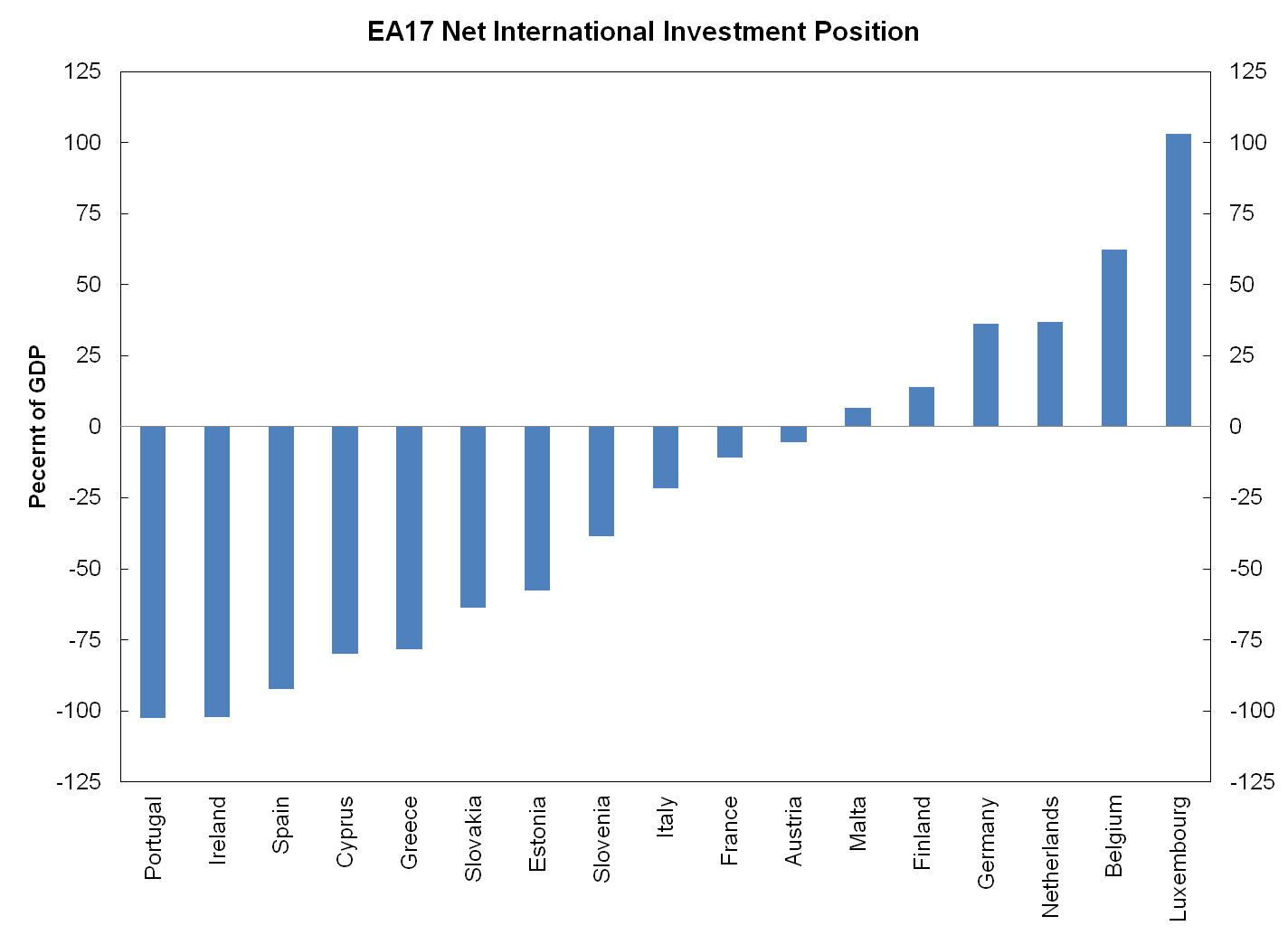
The closest proxy for a nation’s net indebtedness is the net international investment position (as opposed to “external debt” which excludes equity held by nonresidents). Here’s the chart as of 2011: the NIIP is at the end of 2011 and the GDP is the gross domestic product for the whole year.

(click to enlarge)

Note: Greece’s NIIP improved in 2011 (from minus 100% of gdp) due to large revaluation losses suffered by foreigners as Greece financial markets fell in 2011.

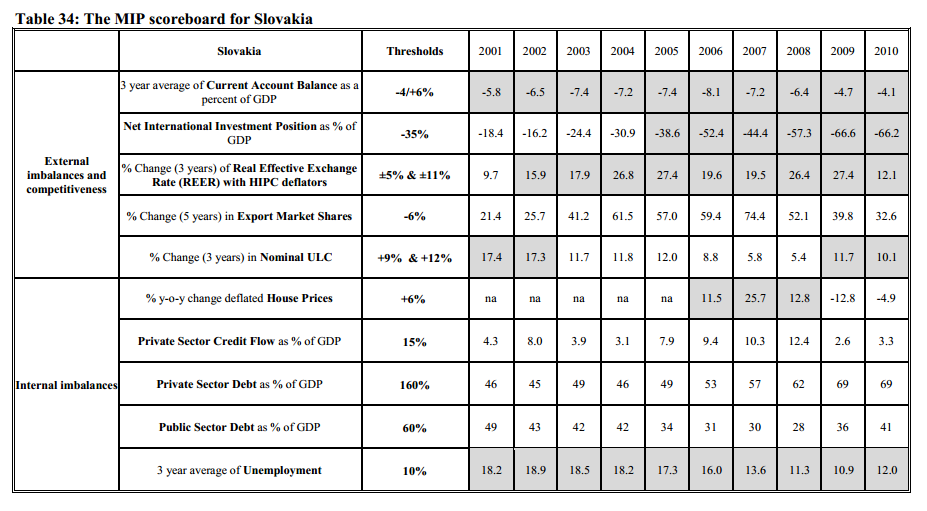
The financial markets is now nervous about Spain and Slovakia’s next in the line if the graph is to be believed and it’s external position is in dangerous territory also – at minus 64%.

According to Wynne Godley, anything between 20-40% of net foreign indebtedness can be highly dangerous. Of course his models also show that there is nothing intrinsically stopping such imbalances from continuing and can go on as long as foreigners do not mind but something has to give in – such as slower growth to prevent the imbalances from continuing before foreigners start minding or a crash.

At this point, Slovakia doesn’t seem to be in trouble with its generic 10-year government bond yield at 3.645% – with its public debt at 43.3% of gdp at the end of 2011 according to Eurostat. This of course means that the domestic private sector is a net debtor (i.e., its financial assets is lesser than its liabilities). A more detailed analysis is required on how internal imbalances will play out and spill over to the external sector. Here’s from Statistical Appendix of the “Alert Mechanism Report”.

(click to enlarge)

Moving on to something different:

Heteredox Economics In Playboy!

Via Twitter:

click to view the tweet on Twitter

John Cochrane of Chicago calls heteredox economists “kooks” and claims he and his colleagues use rigorous models!

Recommended Readings

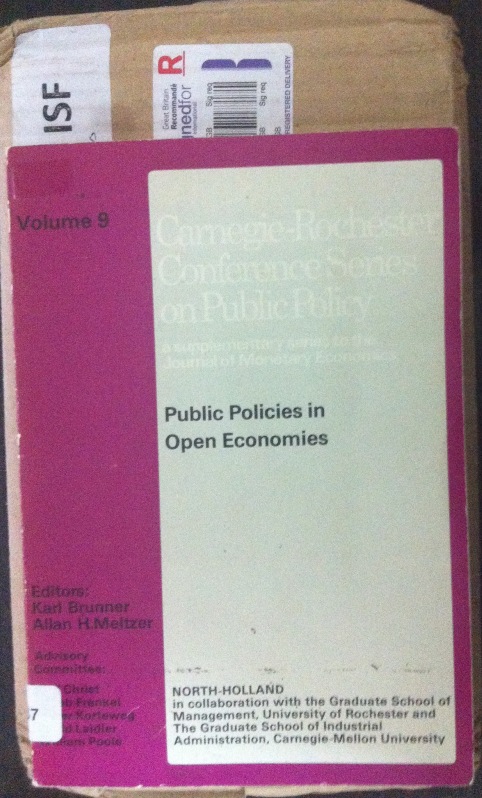
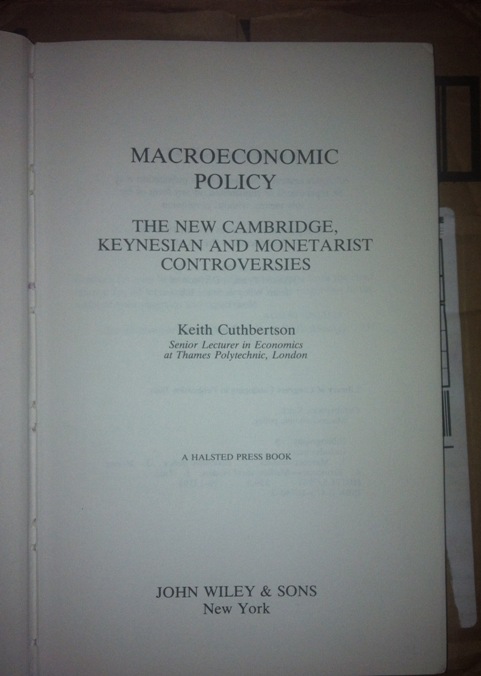
The crisis has a lot of connections with the way Macroeconomics was done in the 1970s and this interests me a lot. Of course the equally important reason was that Nicholas Kaldor and Wynne Godley were highly involved in the public discussions. Here are some books I collected which have special importance to the Cambridge Economic Policy Group (CEPG):

I could manage to only get used copies of the first two books.

The book has the paper New Cambridge Macroeconomics And Global Monetarism – Some Issues In The Conduct Of U.K. Economic Policy, by Martin Fetherston and Wynne Godley and comments by others such as Alan Blinder – which I mentioned in the post Debt Monetization. The book is also available from Wiley but you have to pay $500+ for it!

This one got the title right – it wasn’t Keynesianism versus Monetarism. It was New Cambridge versus Keynesianism versus Monetarism.

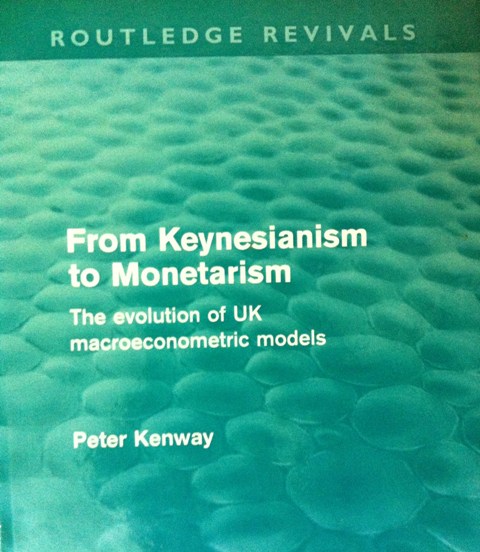
The following book by Peter Kenway was first published in 1994 but was republished recently because the crisis has deep roots with debates in the 1970s!

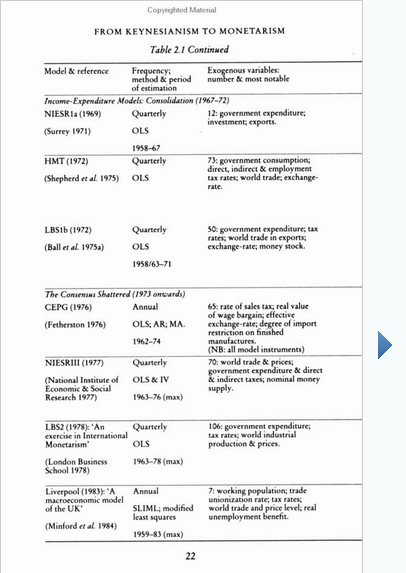
It has nice discussions about the various types of income/expenditure models of the 1970s in the UK with a lot on the CEPG. It gives nice lists of all models – some of them here (via amazon.com preview):

Here’s a short autobiography by Wynne Godley (written around 1999) on how he dissented from the profession. Here’s a Google Books preview from the book A Biographical Dictionary of Dissenting Economists edited by Philip Arestis and Malcolm C. Sawyer

click to view on Google Books

I like this:

 … I had extraordinary difficulty in understanding, not the sentences, but what real life state of affairs mainstream ‘neoclassical’ macroeconomics could possibly be held to be describing. I went through the standard textbooks on macroeconomics and then back to the underlying professional literature (the locus classicus being, as I now see it, Modigliani. 1944 and 1963). I taught myself how to draw the diagrams and solve the equation systems, but for years could not make any connection between these and the real world as I knew it…

One of the things which made Godley dissenting was the proposal to control imports as the paper title suggests:

(click for link to the journal)

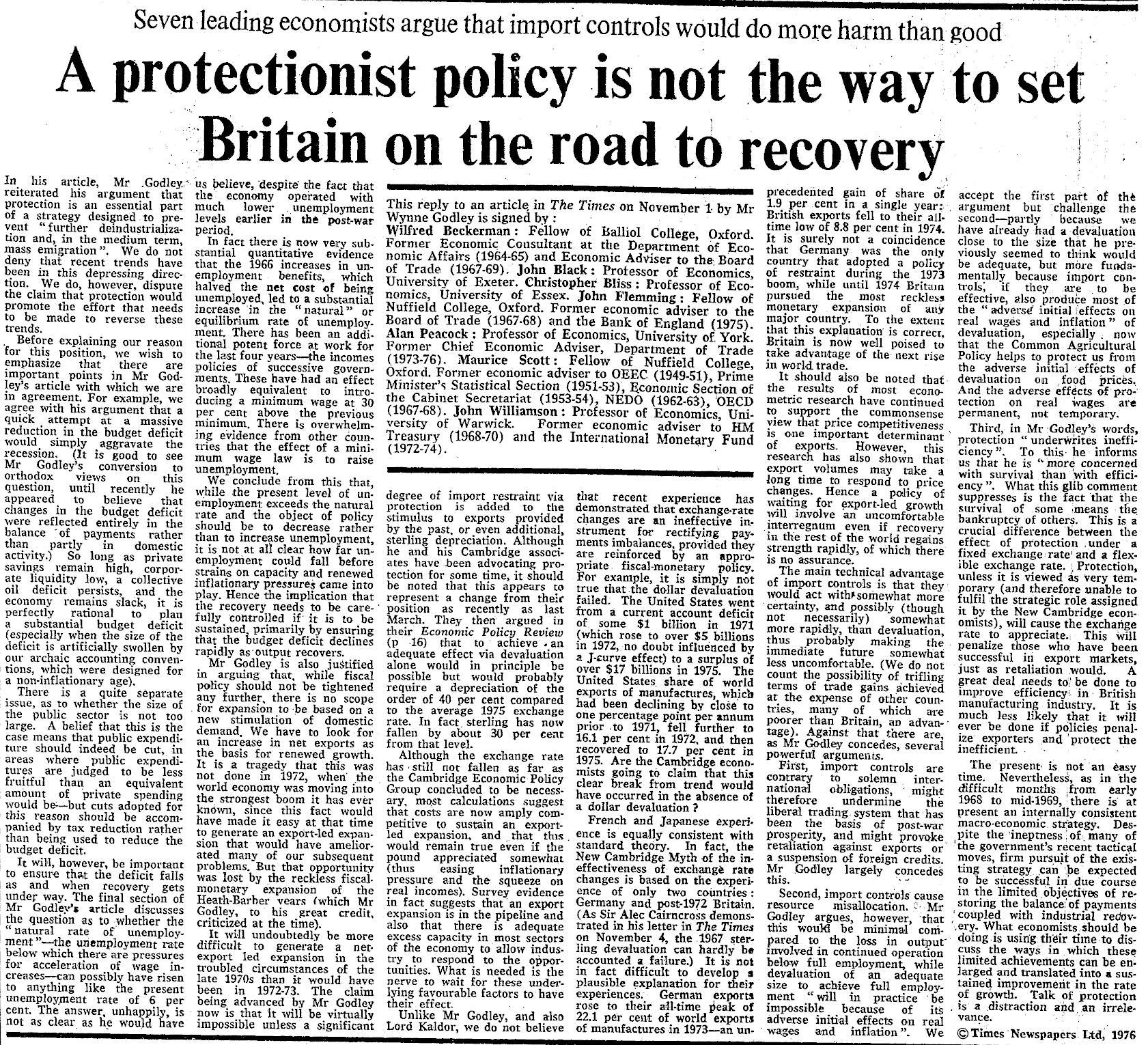
This was met with huge hostility as a Times article (from the late 70s) shows. Economists confused it as “selective protectionism”:

(click to enlarge and click again)

Mosler And His Moslerisms

A few readers/commenters of my blog brought attention to a video of Warren Mosler where he claims that “there is no such thing as a capital flight” – presumably for a nation with a “sovereign currency” with the implication that a Euro Area nations can simply leave the Euro and adopt their original currency without a fear of capital flight post the event.

(Why have capital controls then, if that’s the case?)

Link @22:15

This claim can be easily dismissed by simple balance of payments analysis.

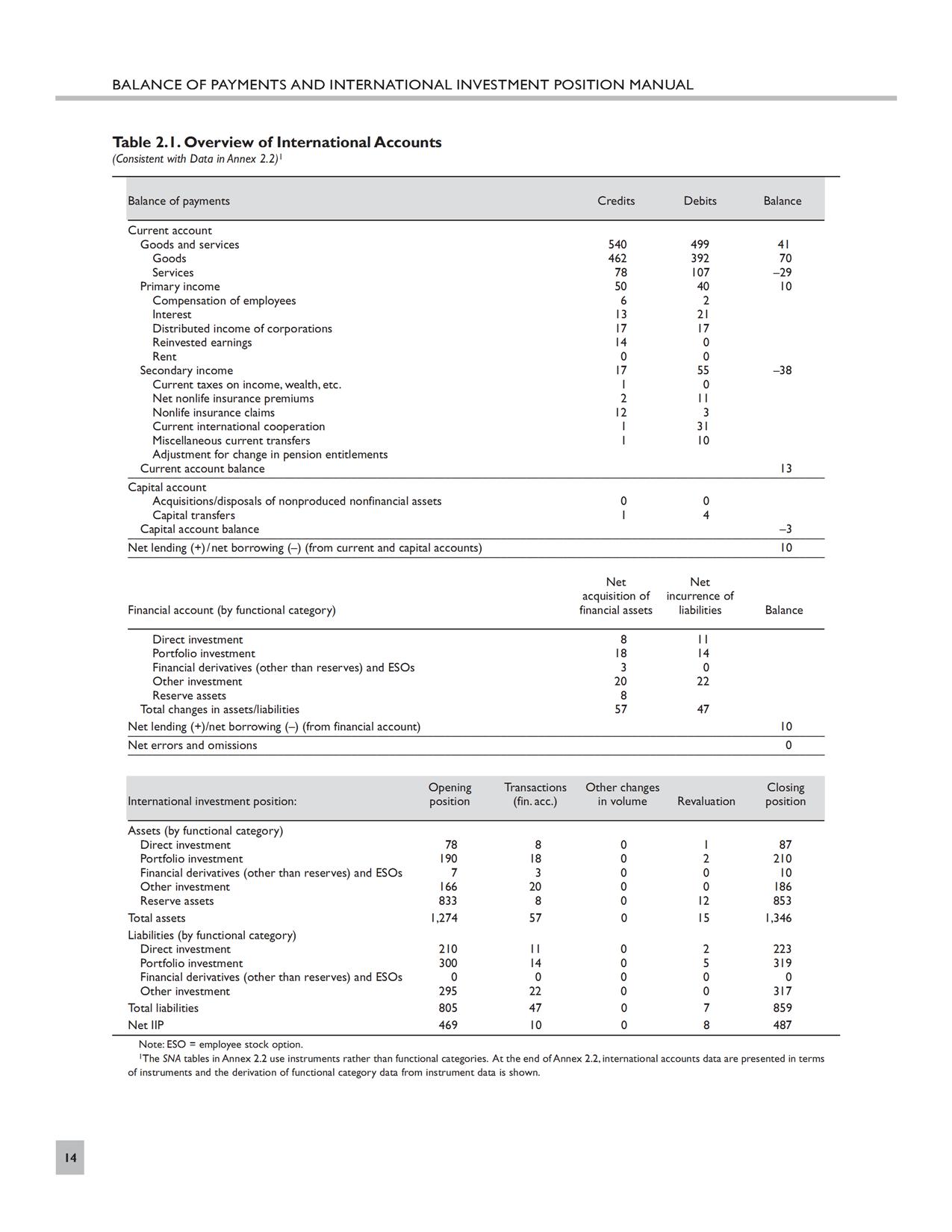
For this I use the IMF’s Balance of Payments Manual (BPM6). First lets look at the format of the BPM6’s numerical example.

The example is below:

(click to enlarge)

Roughly Mosler’s argument is that if a foreigner sells assets denominated in the domestic currency, some other foreigner would need to buy it.

He gives a Bretton-Woods anti-analogy where – presumably – an official foreign creditor can demand gold for conversion and repatriate it home by ship. And that since official convertibility to gold is suspended, there is no capital flight according to this mini-story.

To see there is capital flight, one needs to look at the foreign exchange market microstructure. By the way, the Neochartalists erroneously tend to treat banks as brokers (as opposed to dealers) in the foreign exchange markets. Let us say a foreigner – perhaps a financial institution – with “portfolio investment” in the country in question liquidates assets in the domestic currency and exchanges it at a domestic bank (domestic with respect to the country we are discussing). This “order flow” leaves the bank with a short position in foreign currency which it will try to eliminate. This will lead to a cascading effect because the foreign dealer it may want to offload its position will react itself and hence a series of transactions in the fx markets – leading to a depreciation of the currency.

It may happen that the currency depreciation may bring in an order flow in the opposite direction – thereby leading to a quasi-equilibrium. However if the general expectations is such that the currency may depreciate further then it is hard. If such expectations are formed, there may be even more capital ouflow!

It is precisely here that the central bank may intervene and sell foreign reserves – thereby helping the dealers (both domestic and foreign to offload their undesired positions). So recently there was news of intervention by the Reserve Bank of India in the fx markets. (minor technicality: the reduction of domestic banks’ settlement balances due to the settlement of central bank fx sales will lead to a “fine tuning reverse operation” by the central bank)

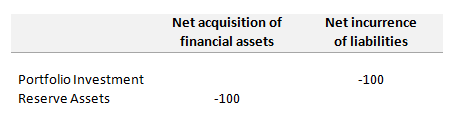
So how does the whole thing look in the balance of payments? The answer is very simple: assuming foreigners sold 100 units of assets – minus 100 due to liquidation of domestic assets and minus 100 due to sale of reserve assets.

So that’s capital flight.

And … like that … it’s gone!

Balance Of Payments: Part 2 – Double Versus Quadruple Entry Bookkeeping

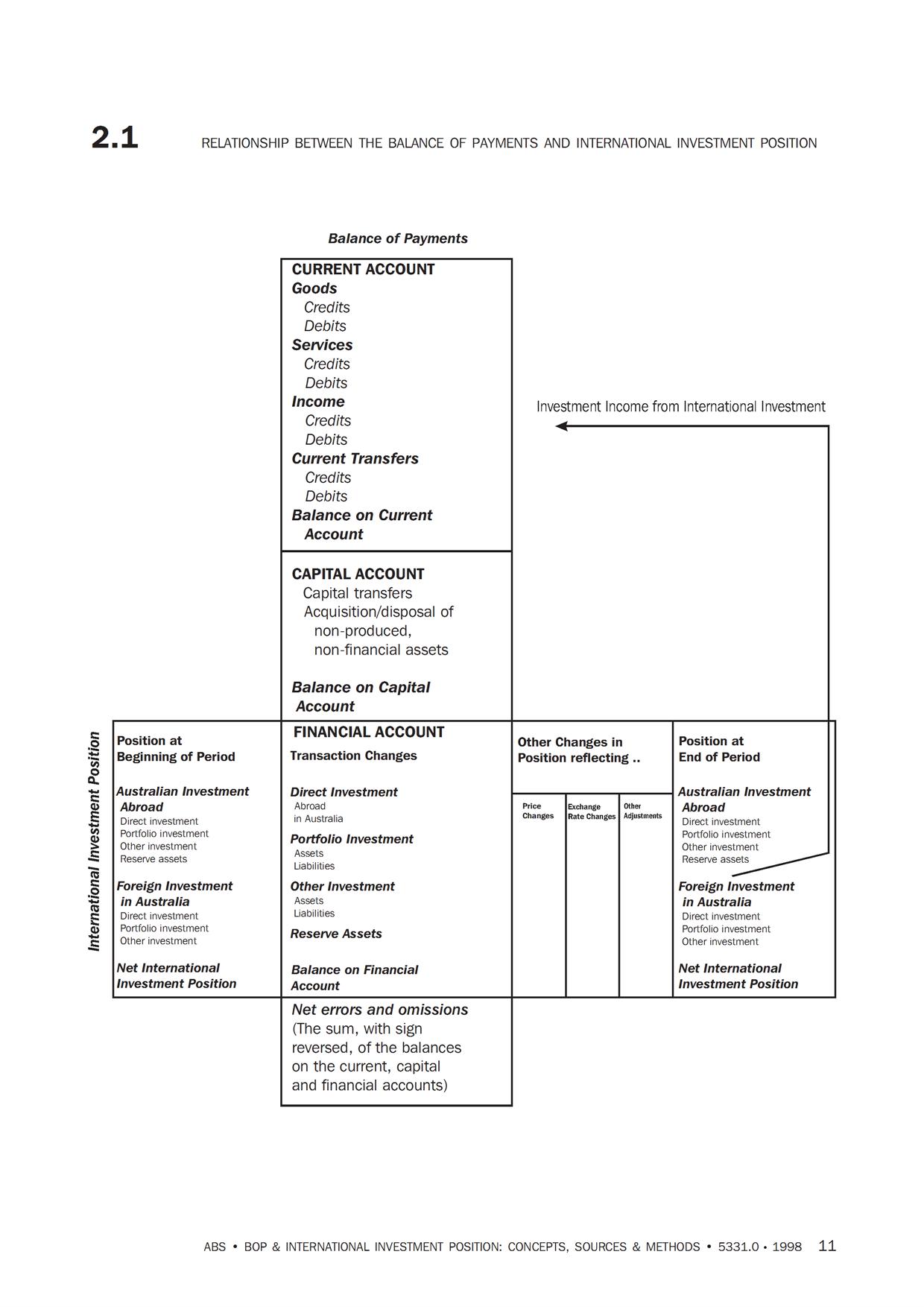
Some time back I had started with the first part of a series of posts on this topic: see Balance Of Payments: Part 1. From the same post, here’s from the Australian Bureau of Statistics’ manual Balance of Payments and International Investment Position, Australia, Concepts, Sources and Methods, 1998

(click to enlarge)

So we have the current account, the financial and the international investment position at the beginning and end of each accounting period. In addition we have, revaluations on assets and liabilities. These arise due to change in the value of assets (such as rise in stock markets) and due to movement of the exchange rate or both.

Also, textbooks use a slightly different language than official statistics and manuals. Textbooks simply use the phrase capital account when they mean the financial account.

I aim to go into each of this and the behaviour of institutions who are involved in the whole process and how it leads to changes in assets and liabilities of all sectors and the consequences. We will see how endemic current account deficits act as a hemorrhage in the circular flow of national income as Wynne Godley would put it and decides the fate of nations as Anthony Thirlwall may have it.

To really appreciate, one needs to have a strong methodology for studying this. One way is to use G&L’s transactions flow matrix but it can get complicated in case of two nations. Needless to say, from a modeling perspective, it is more useful than the usual way of studying balance of payments. However, for appreciating G&L methodology one needs to first understand the usual way of studying this.

Double Entry Versus Quadruple Entry Bookkeeping

In contrast to national accounts, Balance of Payments is based on double entry bookkeeping. Here’s from the IMF’s Balance of Payments And International Investment Position Manual (BPM6), pg 9:

The balance of payments is a statistical statement that summarizes transactions between residents and nonresidents during a period. It consists of the goods and services account, the primary income account, the secondary income account, the capital account, and the financial account. Under the double-entry accounting system that underlies the balance of payments, each transaction is recorded as consisting of two entries and the sum of the credit entries and the sum of the debit entries is the same.

In contrast, national accounts as per SNA2008 or G&L’s way of doing it uses quadruple entry bookkeeping who point out in their book Monetary Economics that:

… Copeland pointed out that, ‘because moneyflows transactions involve two transactors, the social accounting approach to moneyflows rests not on a double-entry system but on a quadruple-entry system’. Knowing that each of the columns and each of the rows must sum to zero at all times, it follows that any alteration in one cell of the matrix must imply a modification to at least three other cells. The transactions matrix used here provides us with an exhibit which allows to report each financial flow both as an inflow to a given sector and as an outflow to the other sector involved in the transaction.

G&L point out that even Hyman Minsky was aware of this. Here’s from the article The Essential Characteristics of Post-Keynesian Economics (page 20):

The structure of an economic model that is relevant for a capitalist economy needs to include the interrelated balance sheets and income statements of the units of the economy. The principle of double entry book keeping, where financial assets are liabilities on another balance sheet and where every entry on   balance sheet has a dual in another entry on the same balance sheet, means that every transaction in assets requires four entries.

The System of National Accounts 2008 (2008 SNA) says (page 21):

In principle, the recording of the consequences of an action as it affects all units and all sectors is based on a principle of quadruple entry accounting, because most transactions involve two institutional units. Each transaction of this type must be recorded twice by each of the two transactors involved. For example, a social benefit in cash paid by a government unit to a household is recorded in the accounts of government as a use under the relevant type of transfers and a negative acquisition of assets under currency and deposits; in the accounts of the household sector, it is recorded as a resource under transfers and an acquisition of assets under currency and deposits. The principle of quadruple entry accounting applies even when the detailed from-whom-to-whom relations between sectors are not shown in the accounts. Correctly recording the four transactions involved ensures full consistency in the accounts.

Simple example: your and my favourite: loans make deposits. The following is a transaction where a household has borrowed some funds from the banking sector:


Introduction To Current Transactions

I mentioned that in recording transactions between residents and nonresidents and presenting it as balance of payments, national accountants use double entry bookkeeping (as opposed to quadruple), so any transaction in the current account necessarily involves another entry in the financial account (ignoring barter and accidental cancellations). However, the opposite is not the case: a transaction on the financial account will lead to another entry in the financial account and not directly in the current account. A purchase of US equities by a UK resident cannot be said to cause or increase the US current account deficit.

One example: if you are are US citizen travelling to the UK and have pay for coffee at the London airport by paying in Federal Reserve notes, it will give rise to an entry in the current account (credit from the perspective of the UK balance of payments) and a debit (increase in assets of UK residents: change in currency notes). This is just transaction among thousands and the question is how is all this to be recorded and more importantly (later) what does it tell us.

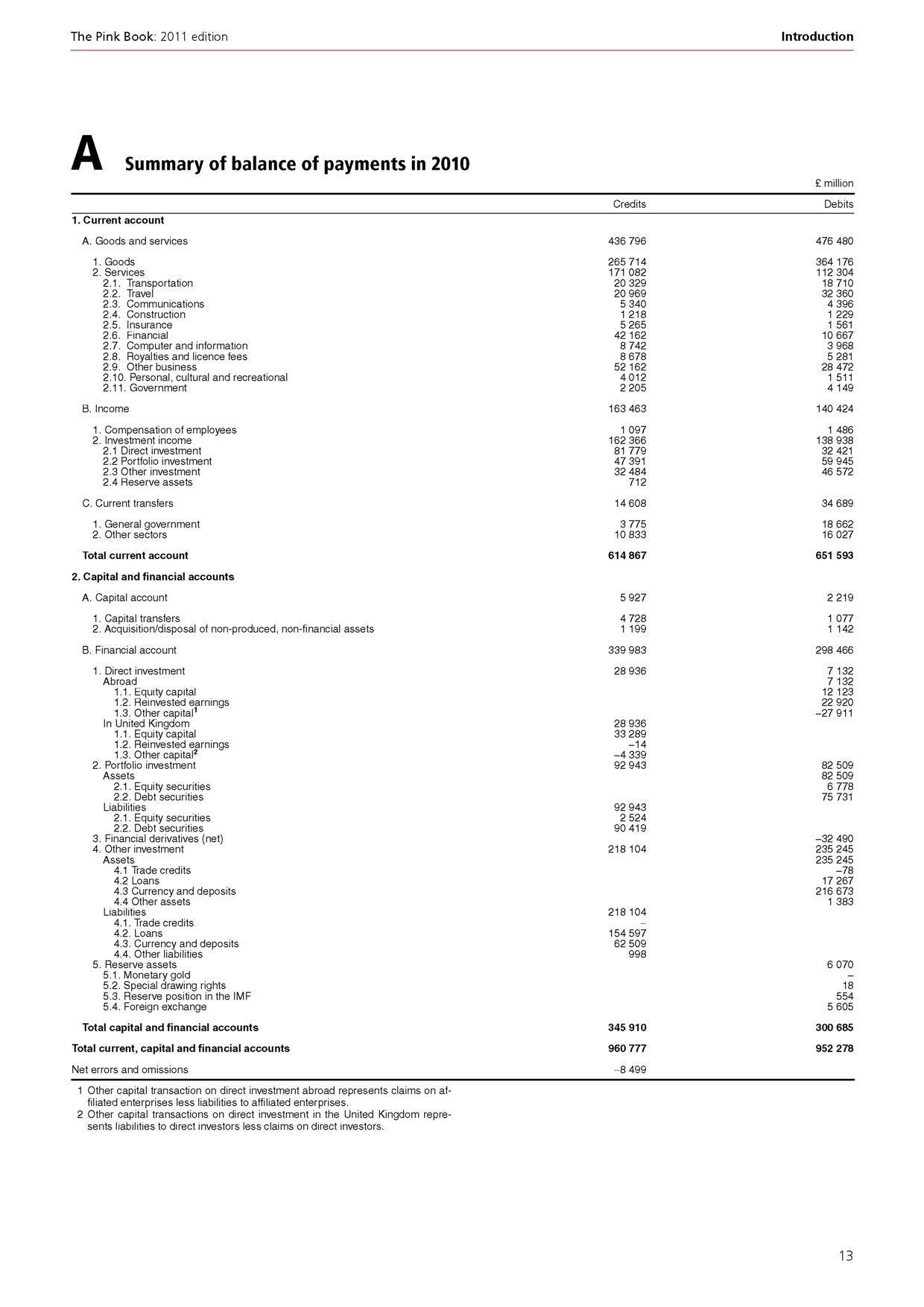
Here’s how a standard balance of payments table looks like (note: this does not include international investment position)

(source: UK Pink Book 2011; click to enlarge)

We will go over details in the next post in this series. For now let us see how this looks for the example presented earlier: A US traveller pays $10 for coffee at the London Heathrow airport with Federal Reserve currency notes. Assuming the current exchange rate, the following (double) entries need to be included in the UK balance of payments:


£ CreditsDebits
Current Account
Goods and Services6.328
Financial Account
Bank Deposits, Foreign Currency Assets6.328


This is a simple example – hardly needing so much background and information but in the next post in this series, we will look at complicated examples where intuitions can easily go wrong. If the above were the only transaction between UK and US residents in the accounting period (quarter/year), this will also change the US indebtedness to the UK by £6.328 or $10 and this will be shown in the international investment positions of the UK and the US. If the exchange rate had moved from the start of the period, revaluations would need to be done to record the closing stocks of assets and liabilities.

Sovereignty In The Euro Area

Nouriel Roubini tweets about Trichet’s plan to save the Euro Zone and wonders about sovereignty:

click to view the tweet on Twitter

Two things:

My guess is Trichet’s plan involves a Euro Area institution setting fiscal policy. Trichet’s plan seems to involve some set of technocrats taking control of fiscal policy of a weak nation and then deflating domestic demand and hence not solving anything at all or making it worse. Here it is – clear from the following:

For the European Union, a fully fledged United States of Europe where nation states cede a large chunk of fiscal authority to the federal government appears politically unpalatable, Trichet said.

An alternative is to activate the EU federal powers only in exceptional circumstances when a country’s budgetary policies threaten the broader monetary union, he said.

Secondly, Nouriel Roubini thinks it “undermines national sovereignty” but the Euro Area nations had given this up long back! So while Euro Area nations surrendered sovereignty long back,  Trichet’s plan involves removing more powers from governments without the possibility of those nations receiving fiscal equalization in return!

Trichet’s plan hence has a “central government” with no fiscal authority! There was no sovereignty to begin with and no institution taking up the sovereignty either.

The Man Who Saw Through The Euro had a profound way of looking at how economies function. Wynne Godley already understood in 1992 that by joining the Euro Area, nations surrender their sovereignty. In his article 20 years back Maastricht And All That, Godley said:

But there is much more to it all. It needs to be emphasised at the start that the establishment of a single currency in the EC would indeed bring to an end the sovereignty of its component nations and their power to take independent action on major issues.

and that:

… I recite all this to suggest, not that sovereignty should not be given up in the noble cause of European integration, but that if all these functions are renounced by individual governments they simply have to be taken on by some other authority. The incredible lacuna in the Maastricht programme is that, while it contains a blueprint for the establishment and modus operandi of an independent central bank, there is no blueprint whatever of the analogue, in Community terms, of a central government.

and also that:

If a country or region has no power to devalue, and if it is not the beneficiary of a system of fiscal equalisation, then there is nothing to stop it suffering a process of cumulative and terminal decline leading, in the end, to emigration as the only alternative to poverty or starvation.

In an article Commonsense Route To A Common Europe in 1991 in The Observer, Godley said:

If we are to proceed creatively towards EMU, it is essential to break out of the vicious circle of ‘negative integration’— the process by which power is progressively removed from individual governments without there being any positive, organic, all-European alternative to transcend it. The nightmare is that the whole country, not just the countryside becomes at best a prairie, at worst a derelict area.

Spanish Banks, Banco de España & TARGET2

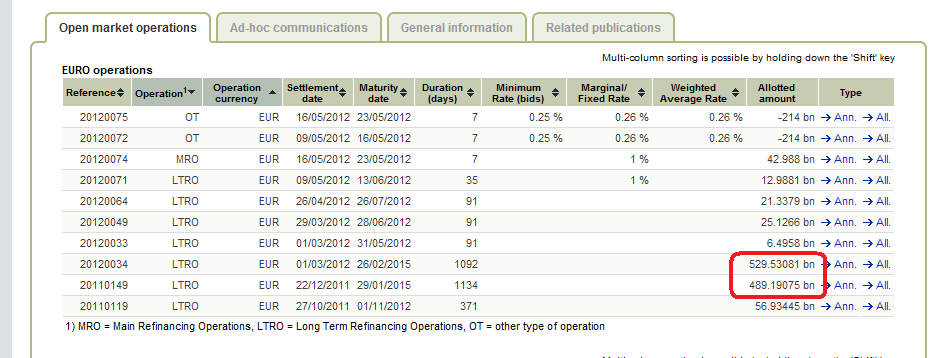
In two big operations in December and February, the Eurosystem lent around €1tn to banks in the Euro Area:

(click to expand, source: ECB)

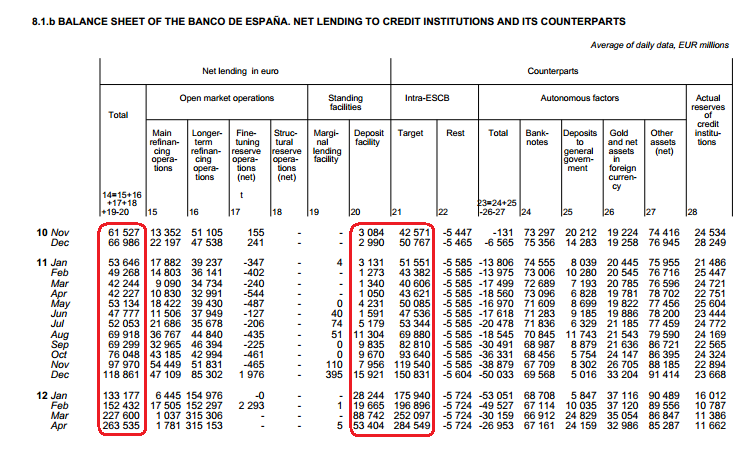
Spanish banks it seems borrowed around €315bn (gross) as per the recently the Banco de España released statistic Financing In The Eurosystem (April 2012):

(click to expand)

Due to the continuing capital flight out of Spain, the TARGET2 liabilities of Banco de España increased in April and averaged €284.5bn in the month. The flow equivalent in the balance-of-payments language may be called the accommodating item.

Born In The U.S.A. – MMT And Monetary Sovereignty

In my previous post on government defaults and its connection to open economies, I had a comment from Sergio Cesaratto (who is full professor of Economics at the University of Siena (Italy)) which I liked. Since I don’t publish comments, I asked him if I could promote it to a post and he sent me an updated version which looks more like a post.

Sergio Cesaratto*

sergio.cesaratto@unisi.it
http://www.econ-pol.unisi.it/cesaratto/
http://politicaeconomiablog.blogspot.com/

The absence of a truly European central bank to guarantee the liquidity of the European sovereign debts aggravated (although it not originated) the crisis by letting the sovereign spreads to spiralling upward. As  consequence of the ECB deficient conduct, according to De Grauwe (2011: 8-10) the periphery’s public debts (PD) moved from a low risk to a high risk equilibrium, in his view from a liquidity to a solvability crisis.  This is not totally correct since the original troubles with the European periphery seem solvability, not of just of liquidity, and indeed it emerged when liquidity was abundant and the sovereign spreads low. According to Wray and his MMT fellows this abundance just delayed the redde rationem of the deficient Eurozone (EZ) monetary constitution, so that they attribute an almost exclusive relevance to the renunciation to national sovereign central bank (SCB) as the explanation of the European financial crisis.

In short Wray argues that as long as a country retains a sovereign currency, that is it retain the privilege to make payments by issuing its own currency and does not promise to redeem the debt at any fixed exchange rate or worse in a foreign currency, then it cannot default and the nationality of the debt holders is irrelevant:

The important variable for them [Reinhart and Rogoff 2009] is who holds the government’s debt—internal or external creditors—and the relative power of these constituencies is supposed to be an important factor in government’s decision to default (…). This would also correlate to whether the nation was a net importer or exporter. We believe that it is more useful to categorize government debt according to the currency in which it is denominated and according to the exchange rate regime adopted. … we believe that the “sovereign debt” issued by a country that adopts its own floating rate, nonconvertible (no promise to convert to metal or foreign currency at a pegged rate) currency does not face default risk. Again, we call this a sovereign currency, issued by a sovereign government. …A sovereign government services its debt—whether held by foreigners or domestically—in exactly one way: by crediting bank accounts. … [it is indeed]  irrelevant for matters of solvency and interest rates whether there are takers for government bonds and whether the bonds are owned by domestic citizens or foreigners. (Nersisyan and Wray 2010: 12-14).

While it is certainly right that if a fixed exchange rate leads to a current account (CA) deficit, a country is exposed to “sudden stops” in capital flows and the higher interest rate necessary to avoid the capital flights and to keep the parity will worsen the external and domestic imbalances Wray seems to hold a different view: for him the CA imbalances are irrelevant:

a country can run a current account deficit so long as the rest of the world wants to accumulate its IOUs. The country’s capital account surplus “balances” its current account deficit…. We can even view the current account deficit as resulting from a rest of world desire to accumulate net savings in the form of claims on the country.

That is, any country with a fully sovereign currency and no promise of convertibility at a given exchange rate can confide on an unlimited foreign credit. But for most of the countries countries, the no-promise of convertibility at a given exchange rate is precisely the case in which they will not get (cheap) foreign credit. Indeed, it is by promising at-pair convertibility that periphery countries can finance in a cheap way their CA deficits.  This will, of course, often create future problems, but certainly a floating exchange rate would discourage cheap foreign lending. One may also say that a competitive (real) exchange rate policy is what periphery countries need, a position largely shared by development economists nowadays, not least because it is not conducive to a fictitious foreign-borrowing-led growth.

Wray (2001)  elsewhere admits that the irrelevance proposition that any State

can run budget deficits that help to fuel current account deficits without worry about government or national insolvency

applies indeed only to the US: precisely because the rest of the world wants Dollars. But surely that cannot be true of any other nation. Today, the US Dollar is the international reserve currency—making the US special. … the two main reasons why the US can run persistent current account deficits are: a) virtually all its foreign-held debt is in Dollars; and b) external demand for Dollar-denominated assets is high—for a variety of reasons.

The main reason seems that the U.S. issues the main reserve currency and you issue a liability (so to speak, it’s fiat money) internationally fully accepted even without a commitment to convert it in something else.  So, what Wray say, with a sovereign currency PD and CA debts are not a problem only apply to the U.S.

With fixed exchange rates, it is not so much the promise to redeem the debt at a fixed exchange rate or in a foreign currency that creates problems. It would not be a problem in CA surplus countries, for instance. The problem is that fixed exchange rates lead periphery countries to a CA deficit, to the fear of devaluation, unsustainable interest rates, “sudden capital stops” etc. Recall that the European unbalances initially grew with a ECB pursuing very low interest rates that with financial liberalization and the end of a devaluation risk led to the bubbles in the periphery and eventually to the unbalances. This is not to say that the role of a SCB is not relevant: quite the opposite.  Lately, the ECB should and could have operated to avoid the increase in the sovereign spread, but it could not have avoided the preceding sequence of events.

It may be added that with the right institutional setting, the EZ could be a perfect U.S.-MMT style country. With the full backing of the ECB the infra-European financial imbalances would be perfectly sustainable for a region with external balanced accounts that, what’s more, issues an international currency. The institutional change required for the EZ to resemble the U.S. includes the transfer of the conspicuous part of existing PDs along with many government budget functions to a federal government (to avoid moral hazard),[1] while national States would work as the American local States. Monetary policy should cooperate with fiscal policy to pursue full employment and, subordinated to this, price stability. Federal transfers from dynamic to troubled areas should dramatically increase while minimum standard welfare rights should be universally recognised to all European citizens. Labour mobility and infra-EZ direct investment should be incentivised. Actually, fiscal pacts were already includes in the Maastricht (1992) and Amsterdam (1997) treaties, in which the European periphery exchanged budget discipline with German inflation ‘credibility’ and low interest rates. As the subsequent experience has shown, the troubles have not derived from fiscal indiscipline. Part of the problems certainly derived from a deregulated finance. At the European and national level, financial resources should therefore be re-regulated to sustain public, social and environmental investment rather than construction or consumption bubbles. Public or semi-public investment banks should be used at both levels to this purpose. Be as it may, at the time of writing this project appear still too challenging for real Europe, a club of independent states. Short of this full institutional unification, a pro-active monetary and budget policies at the European level, particularly in the surplus countries, would of course also go into the direction of a solution.

References

De Grauwe Paul  (2011) Managing a fragile Eurozone, Vox

Nersisyan Y., Wray R.L. (2010), Does Excessive Sovereign Debt Really Hurt Growth? A Critique of This Time Is Different, by Reinhart and Rogoff, Working Paper No. 603, Levy Institute June 2010

Wray L.R.  (2011), Currency Solvency and the Special Case of the US Dollar

(this post is a section of a longer essay on the European crisis; I originally sent a summary to Concerted action as a comment to his latest post. I thank Ramanan for promoting it to a post and, without implications, Eladio Febrero for comments).


* Sergio Cesaratto is full professor of Economics at the University of Siena (Italy).

[1] As Nersisyan and Wray 2010: 16 argue:

With a sovereign currency, the need to balance the budget over some time period determined by the movements of celestial objects or over the course of a business cycle is a myth, an old-fashioned religion. When a country operates on a fiat monetary regime, debt and deficit limits and even bond issues for that matter are self-imposed, i.e., there are no financial constraints inherent in the fiat system that exist under a gold standard or fixed exchange rate regime. But that superstition is seen as necessary because if everyone realizes that government is not actually constrained by the necessity of balanced budgets, then it might spend ‘out of control,’ taking too large a percent of the nation’s resources.